Spiritual Lessons from Three Inspiring Christians
By Leslie Ludy

This past year has been the hardest season of my life. Circumstances beyond my control have caused me to feel, as Paul said, “…burdened beyond measure, above strength…” (2 Cor. 1:8). And through it all, the word that keeps coming into my heart and mind is “overcoming.”
As Christians, we have the power of God to overcome all that seeks to hinder, discourage, and defeat us. But many of us never step into the strength and victory that is ours in Christ. It’s all too easy to succumb to apathy and lethargy rather than choosing to “rise up in the strength of God and resolve to conquer,” as Catherine Booth stated.
Whenever I am sensing a need to “rise up in the strength of God” and overcome, I always find incredible strength and encouragement from stories of victorious Christians who have gone before me. In the following three stories, I want to share a few of their defining moments that led to key decisions and overcoming, conquering, victorious outcomes in spite of intimidating odds.
Though Christian heroes’ lives often feel unattainable, the reality is that they were ordinary people who chose to become fully available to an extraordinary God. These significant moments in their lives offer some inspiring and practical takeaways that can apply to our lives today. If you are facing obstacles in your life and need to learn experientially what it means to be an overcomer, I pray these stories will encourage and strengthen you as much as they have me!
· · ·
#1 Overcoming Spiritual Blindness
George Müller’s Life-Changing Awakening
“Anoint your eyes with eye salve, that you may see.” Revelation 3:18
George Müller, known for his ministry to the orphan and street children of Bristol, England in the 1800s, did not set out to become a rescuer of vulnerable children. In fact, he had a very different plan laid out for his life. As a young man, George had a thriving preaching ministry throughout Bristol but found himself thinking more and more about foreign missions. His brother-in-law, Anthony Groves, ran a mission station in Baghdad, and as George read Anthony’s letters he felt a growing desire to join him. The life of a foreign missionary sounded so much more exciting than that of a pastor in England. One day George received a letter from Baghdad with 200 pounds so that he and his family could leave England and become full-time missionaries there.
George was beyond excited and rushed home to tell his wife the news. He and his family and ministry colleague began making plans to become missionaries overseas. But something happened one day that changed everything.
One foggy afternoon George was visiting a member of his congregation in the poorest part of Bristol. The streets were muddy and dreary and filled with huge rain puddles. Destitution was everywhere. A little five-year-old girl came up to him carrying a toddler boy on her back who wore only a torn pair of trousers. She asked for a shilling. He learned that her mother had died from cholera, and her father had gone to the mines and never returned.
As George gave her the shilling, his heart was strangely stirred. He had seen little children like this every day during his ministry, but now it was as if he was seeing them for the first time. What would happen to these two little children? Without anyone to care for them, was there any hope for their future? He thought about the fact that there were thousands of children in this same hopeless situation all over the streets of Bristol.
As George walked along the muddy streets, he came to a decision. He didn’t need to go to the mission field in Baghdad or anywhere else. He was standing in the middle of a mission field. Surely these little helpless children were among the neediest in the world. Baghdad, with its foreign intrigue, might sound more exciting, but there was also work to be done in dirty, overcrowded Bristol, England.
He did not know how to go about it or what a lone person with no regular income could do, but he knew one thing: with God’s help he would do something to help the poor homeless children of Bristol. His pledge was this: “God has given me a mission field right here, and I will live and die in it.”
The result of that decision to stay and invest in his own backyard mission field had an immeasurable impact upon countless lives. Over the course of his life, George took full responsibility for over 10,000 orphans. He provided so many educational opportunities for underprivileged children that he was even accused by some of raising the poor above their natural station in British life. He established 117 schools which offered Christian education to more than 120,000 children. He ran his orphanage entirely by faith, and he ran it with excellence.
When George died, a secular newspaper wrote that he had, “robbed the cruel streets of thousands of victims, the jails of thousands of felons, and the poorhouses of thousands of helpless waifs.”

Our Spiritual Takeaway: Ask God for Eyes to See
Most of us are naturally blind to the needs that are right in front of us. We often believe that real needs only exist in far-away lands. Some of us romanticize the idea of going somewhere exciting to do big things for God while overlooking the mission field opportunities in our day-to-day lives. Others of us are simply so preoccupied with the cares and distractions of life that we remain blind to the people around us who are in desperate need of God’s light and love. This is a very common blind spot for us as Christians.
Even George Müller — a strong believer and powerful preacher who had a heart for missions — did not really see the desperate need of the street children in his own city until that moment when God opened his eyes.
In Revelation 3:18, Jesus gives a specific set of steps we can take to overcome spiritual apathy. One of them is to, “Anoint [our] eyes with eye salve, that [we] may see.” In my own life, I have found it to be truly life changing to begin praying this prayer: “Lord, give me eyes to see what You see.” When we make ourselves available to really see what God sees, He opens our eyes to the needs and burdens of those around us. When we pray that prayer, He will show us how to be His hands and feet to a lost and dying world, right where we are today.
It might be sharing the Gospel with an unsaved friend or co-worker. It might be investing into the needs of our communities — such as visiting the elderly, the homeless, or children in foster care. It might be investing into the spiritual and practical needs of our own families. These steps of obedience may not always seem exciting or romantic at first, but when we ask God to anoint our eyes to see what He sees, our lives will become eternally fruitful. And even when we are struggling with our own issues, we can find incredible joy in taking our eyes off ourselves and our own pursuits, and working in cooperation with God’s Spirit to build His Kingdom, one precious soul at a time.
· · ·
#2 Overcoming Self-Protection
Keith Green’s Big Risk
“For whoever desires to save his life will lose it, but whoever loses his life for My sake will find it.” Matthew 16:25
Keith Green was a hippie-turned-Christian musician of the 1970s. His music had been growing in popularity, and he had the opportunity to make money and become a “Christian celebrity” — as long as he didn’t make people feel too uncomfortable. It would have been so easy to stay in a self-protective bubble and enjoy using his talents to simply encourage and entertain the Christian community.
But Keith was an unusual breed of Christian artist; he genuinely did not care about applause and accolades. He was passionate about bringing glory to God with every song he wrote and every concert he performed.
One summer, Keith was invited to do the closing concert at a huge outdoor Christian festival, called Jesus Northwest. As the festival reached its final day, Keith’s heart was heavy. He and his wife Melody had seen far more frivolity than focus on Christ among the crowd of so-called Christians. As he sat in his trailer preparing to give the final concert of the festival, he began weeping and crying out to God for direction on what to say and how to reach the audience with something real and lasting.
In her book, No Compromise, Melody Green later described the scene:
[Keith was] troubled — not about what had happened at the festival, but what had not happened. We’d all heard that the emphasis of the festival had been on music — lots of it, and loud. There were some speakers, too, but hardly anyone had given a challenge for change or commitment.
The place was packed, but some were saying there had been no real move of God, that it was just one big party. Keith … felt strongly that if nothing happened it was a waste of a festival.
There was a piano in the trailer, and Keith crawled under it to get alone with God and pray. He’d be closing out the festival in just a few minutes. From where I was praying I could hear Keith softly crying … Keith prayed out loud, “O God, what do You want me to say? What do You want me to do?”
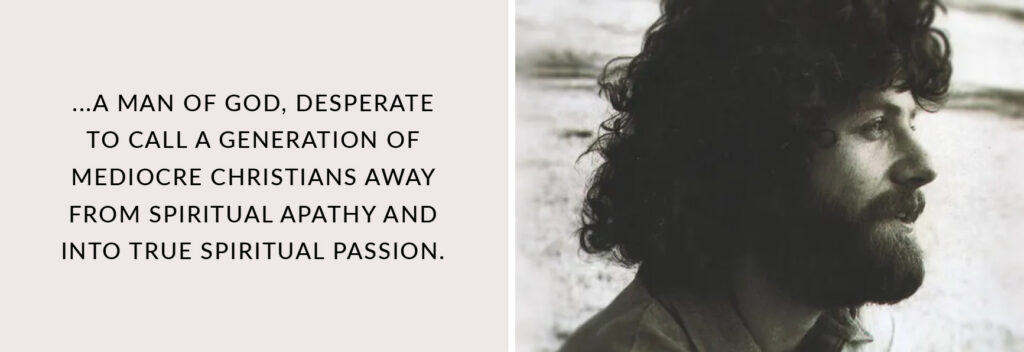
When Keith stepped onto the stage that night, it was not as a musician wanting to entertain an audience or perform his songs well — it was as a man of God, desperate to call a generation of mediocre Christians away from spiritual apathy and into true spiritual passion. Melody recounted moments from that unforgettable concert:
Wiping tears from his eyes, Keith told the audience, “I was listening to everybody singing worship songs before, and nobody deserves praise and worship but Jesus. It’s a beautiful thing.
“But what if your wife said ‘I love you’ but you knew she didn’t honor you and love you in her heart. That you weren’t the most important person on earth to her, and in fact, she had a couple of other men she liked to look at and think about more than you? How sick would it be for you to hear, ‘Oh, darling, I love you!’ What do the words ‘I love you’ mean? If you praise and worship Jesus with your mouth, and your life does not praise and worship Him, there’s something wrong.
“I want you to go away from here broken and blessed in that order. I don’t want you to go away from here under condemnation. But I want you to get broken before God because unless you’re a broken vessel, He can’t put you back together the way He wants you.
“In the Old Testament it says, ‘These people draw near with their mouths, but their hearts are far from Me.'”
The crowd had gotten quiet now. I noticed one young guy toward the front wearing cut-offs and a “Jesus Is Lord” T-shirt. He leaned forward with a serious look on his face … Keith looked to the sky and said, “I depend on You, Lord Jesus…”
His words had the effect of a shotgun blast. The crowd sat in stunned silence — the first silence I’d heard all night. I glanced quickly at the guy in the Jesus T-shirt again. He was just sitting there with his mouth open. I wondered what he was thinking as Keith continued:
“How many of us care about the people living next door to us? How many of your neighbors have never seen anything more than a little fish on your car? … As for me, I repent of ever having made a record or ever having sung a song unless it’s provoked people to follow Jesus, to lay down their whole lives before Him, to give Him everything. It doesn’t cost you much to follow Jesus — just everything!
“The requirement for salvation is not just a prayer. The requirement is an open, totally empty heart that’s ready to be full of Jesus Christ. After saying the sinner’s prayer, if in a few months your friends can’t tell that you’re born again, if your relatives can’t see a change in you, if your teacher can’t see that you’re a Christian, you’re probably not!
“Because let me tell you something, when someone’s born again they get excited! It changes the way they live, what they do, how they speak, how they act, what they do with their money, their cars, their girlfriends — it’s all different! Then how come it looks the same? How come Christians are trying to ride the line?…
“If you want Jesus Christ to completely take over your life, you’re willing to die for Him, give Him every possession, every friend, every loved one, every plan, every hope, every dream. You’re willing to give it all up if necessary. I’m not saying that’s what He wants you to do, but you are willing. If you’re willing to come before His throne empty-handed, raise your hand. If you can’t look Him in the eye and know you’ve been living a pleasing life before Him, get your hand up and make it right. Jesus Christ is not your Savior unless He’s the Lord of your life, and Lord means He owns and controls — lock, stock, and barrel — your destiny, your future, and your present. And He throws away your past as far as the east is from the west.”…
Hands were up everywhere. Thousands of them. Not only that, weeping and loud crying broke out all across the open, grassy field. It was awesome. I could hear people sobbing and choking out prayers to God.
Then Keith asked everyone who was making Jesus Lord of their life for the first time to stand. To my shock, almost everyone in the crowd stood. Keith was so surprised he thought they must not have understood him. So he clarified it.
“This is not a rededication. This is the first time, the first time you’ve ever understood what making Jesus Lord really meant. Do you really mean it? Wow!”…
Then Keith called [his wife and friends] up to the stage, and we all led worship with Keith for about half an hour. That’s the way the festival ended. Keith slipped quietly down from the stage, raw and totally exhausted. He had delivered his soul … As we drove across the festival grounds on our way back to our motel, we saw lots of people lying before God out in the fields or on their knees — praying. It felt like a holy hush had descended and was still lingering … gripping every hungry heart.
Our Spiritual Takeaway: Lay Everything On the Altar
In studying Keith Green’s life leading up to that festival, it’s clear that he was able to speak so powerfully to the audience that day because he had first allowed God to do a deep purifying work within his own soul. He would not have been able to challenge that crowd to come away from mediocrity and compromise unless he had walked through a similar process in his own life. Because he had laid everything — his music, his reputation, his future, his family — on the altar, God was able to powerfully work through him to call his fellow Christians out of mediocrity and into a vibrant relationship with Christ.
If we are willing, God can do the same through us — maybe not by presenting a gripping message at a large outdoor festival, but by living out a vibrant faith and spiritual fire that inspires the Christians around us to pursue a passionate relationship with Christ. When we have surrendered everything and have nothing to lose, that’s when we have everything to gain.
· · ·
#3 Overcoming Fear
Don Richardson’s Defiance of Enemy Lies
Be vigilant; because your adversary the devil walks about like a roaring lion, seeking whom he may devour. Resist him, steadfast in the faith. 1 Peter 5:8–9
When missionary Don Richardson first arrived in the primitive jungles of New Guinea in the early 1960s, the very atmosphere seemed to mock his efforts to bring the Gospel there. He and his wife had a spiritual burden to reach the violent and cannibalistic tribes deep within the interior of the jungle — miles and miles from all civilization. But when Don reached the area he had been so burdened for, he began to have second thoughts. The enemy seemed to mock his desire to bring the Gospel to such a depraved group of people in such a dangerous location.
In his book Peace Child he wrote:
The wildness of the locale seemed to taunt me. Something in the mood of the place seemed to say mockingly, “I am not like your tame, manageable Canadian homeland. I am tangled. I am too dense to walk through. I am hot and steamy and drenched with rain. I am hip-deep mud and six-inch sago thorns. I am death adders and taipans and leeches and crocodiles. I am malaria and dysentery and filariasis and hepatitis.
“Your idealism means nothing here. Your Christian gospel has never scrupled the conscience of my children. You think you love them, but wait until you know them, if you can ever know them! You presume you are ready to grapple with me, understand my mysteries and change my nature. But I am easily able to overpower you with my gloom, my remoteness, my heedless brutality, my indolence, my unashamed morbidity, my total otherness!
“Think again, before you commit yourself to certain disillusionment! Can’t you see I am no place for your wife? I am no place for your son. I am no place for you…”
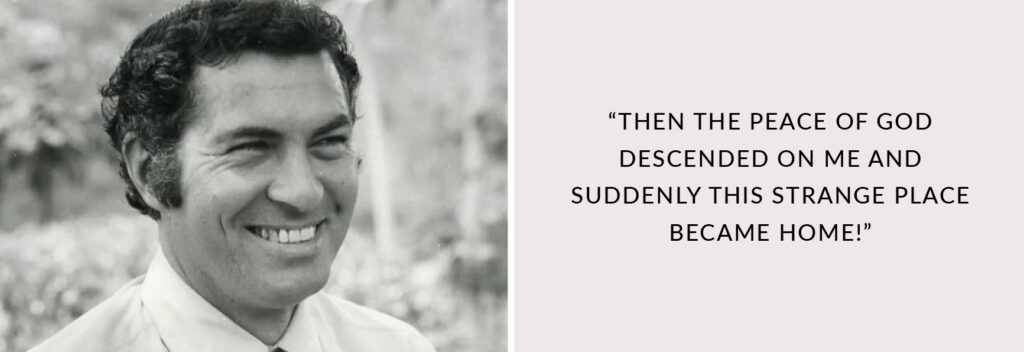
It’s only a bluff, I thought. This swamp also is part of my Father’s creation. His providence can sustain us here as well as anywhere else. Then the peace of God descended on me and suddenly this strange place became home! My home! I turned to [my fellow missionaries] and said, “This is where I want to build!”
Our Spiritual Takeaway: Call the Enemy’s Bluff
The enemy specializes in “smoke and mirrors” — creating an illusion of power and intimidating us into apathy or silence. As God’s children, Satan does not actually have power over us. And yet we so often allow his noisy threats to paralyze us with fear. Whether we are taking steps forward in obedience to God, seeking to grow spiritually, or reaching others with hope and truth, the enemy will do everything in his power to intimidate us and get us to turn back in fear. Like Goliath boasting and threatening David, or the enemies of Israel harassing and intimidating Nehemiah as he sought to rebuild the wall of Jerusalem, the enemy will not be silent in his threats against us — unless we choose to call his bluff.
Both David and Nehemiah refused to listen to the enemy’s loud boasts and threats. Like Don Richardson, they called his bluff and stood their ground. They moved forward boldly in what they had been called to do, and soon the enemy realized he could not stop them.
One of my favorite Scriptures is Nehemiah 4:15. After so many attempts to thwart Nehemiah’s work, the enemies of Israel finally realized that their bluff had been called:
When our enemies heard that it was known to us, and that God had brought their plot to nothing, that all of us returned to the wall, everyone to his work. Nehemiah 4:15
The enemy cannot stop us from moving forward as long as we refuse to listen to his lies. As Leonard Ravenhill said, “Satan fools and feints, blows and bluffs, and we so often take his threats to heart and forget ‘the exceeding greatness of God’s power to usward.’”
· · ·
Though these stories and circumstances were all very different, these men learned how to overcome — not by their own merit, power, wisdom, or talent, but by the blood of the Lamb — by the Name that is above every name. (See Revelation 12:11.) And not only were their own lives changed, but countless other lives were impacted as well.
We don’t need to have special qualifications or skills to be overcomers. We simply need to make ourselves completely available to God.
No matter what obstacles you are facing today, never forget the beautiful promise: “Yet in all these things we are more than conquerors through Him who loved us” (Rom. 8:37).
May this become our reality. God has enabled us to be overcomers — one step of obedience at a time.

This article was originally published in Issue 51.
For more content, explore our article collection.